
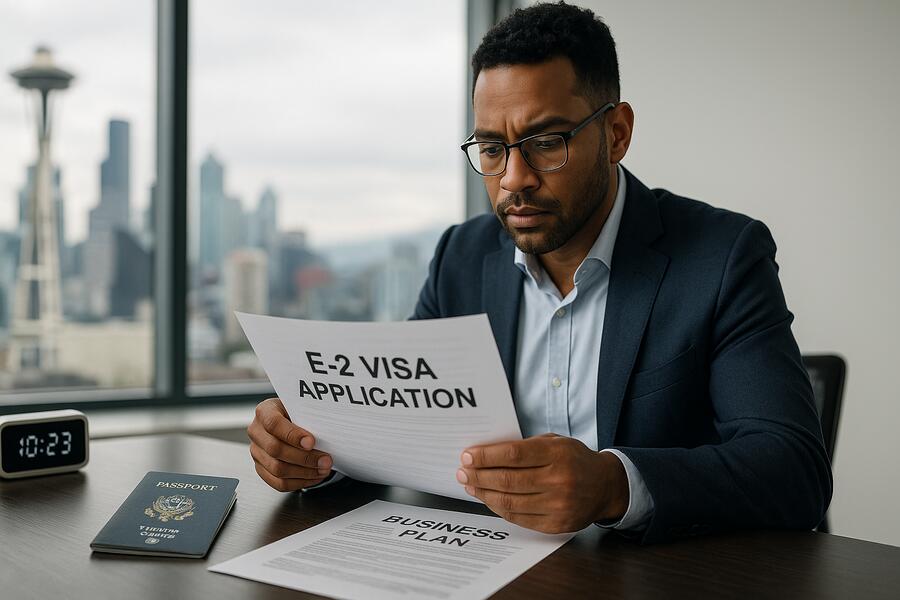
The E-2 Treaty Investor Visa is a highly sought-after option for foreign nationals from treaty countries who wish to invest a substantial amount of capital in a U.S. business. While it offers a fantastic opportunity, a common question among prospective investors is: “How long does the E-2 visa application process take?” The answer isn’t always straightforward, as the E-2 visa processing time depends on several factors, including where you apply and the completeness of your petition.
At Ankeny Law, with offices in Seattle, WA, and Vancouver, BC, we provide comprehensive e-2 visa guidance to entrepreneurs and businesses. Our goal is to set realistic expectations and help streamline your E-2 application. Let’s break down the typical E-2 visa timeline based on the application route.
E-2 Visa Processing Timelines: Consular vs. USCIS Routes
There are two primary ways to apply for E-2 status: through a U.S. consulate or embassy abroad (consular processing) or by filing a change of status petition with USCIS if you are already in the U.S.
Consular Processing: Applying from Abroad
Most E-2 visa applicants apply through a U.S. embassy or consulate in their home country or a third country. This process generally involves a detailed review of the application package, an interview, and then visa issuance.
- Preparation Time (1-3 months): Before you even submit anything, you’ll need to form your U.S. business entity, open bank accounts, secure a physical location, make the qualifying investment, and develop a comprehensive business plan. This foundational work is critical and can take 1-2 months for business formation alone. Gathering all supporting documents, including certified translations, also adds to this initial phase.
- Document Review & Submission (1-3 months): Once your complete E-2 package is submitted to the consulate, the E-Visa Unit or equivalent department will review it. This review period varies significantly by embassy location and workload. For example, the U.S. Embassy in London might take approximately 45 days for its initial registration review.
- Interview Scheduling (1 week to several months): After the document review, the consulate will invite you for an interview. Wait times for interview appointments can fluctuate dramatically. Some well-staffed posts (like London, Tokyo, Seoul, Ottawa) might offer appointments within a month or two, while high-demand locations could have much longer waits (4-8+ months). You can check current wait times on the Department of State’s website.
- Visa Issuance (3-10 business days): If your interview is successful and no further administrative processing is required, the visa is typically issued within 3-5 working days, followed by 2-3 days for passport return.
- Total Consular Processing: From initial package submission to visa issuance, the total consular processing time can range from 3 to 8+ months on average, with 2-4 months being typical for straightforward cases at posts with good staffing.
💡 Key Takeaway: Consular processing times for an E-2 visa are highly variable, primarily depending on the specific embassy’s workload and interview appointment availability. Thorough preparation of the business and application package is crucial to avoid delays.
Change of Status: Applying from Within the U.S.
If you are already in the U.S. in a valid non-immigrant status (e.g., B-1/B-2, F-1, H-1B), you may be eligible to file Form I-129, Petition for a Nonimmigrant Worker, with USCIS to change your status to E-2. This allows you to remain in the U.S. while your application is processed.
- Standard Processing (2-8 months): USCIS standard processing for E-2 change of status petitions can take anywhere from 2 to 8 months. Recent data has shown median processing times around 2-3 months for standard processing in FY 2024.
- Premium Processing (15 business days): This is a key advantage of applying for a change of status with USCIS. For an additional fee ($2,805 in 2024), USCIS guarantees a response (approval, denial, or Request for Evidence – RFE) within 15 business days. This option is not available for consular processing.
- No Visa Stamp: An important distinction: an approved change of status with USCIS grants you E-2 status *within* the U.S. It does not provide an E-2 visa stamp in your passport. If you leave the U.S., you would typically need to apply for an E-2 visa stamp at a U.S. consulate abroad to re-enter in E-2 status.
💡 Key Takeaway: If you are already in the U.S., a change of status to E-2 via USCIS offers the option of premium processing for a much faster decision. However, remember this doesn’t include a physical visa stamp for international travel.
Factors Affecting E-2 Processing Speed
Several elements can influence how quickly your E-2 visa application progresses:
- Completeness and Quality of Application: A well-organized, comprehensive, and clear application package with all required supporting documentation and a robust business plan is paramount. RFEs (Requests for Evidence) from USCIS or consulates can significantly delay processing.
- Consulate/Service Center Workload: Workloads fluctuate. Some embassies are known for faster processing (e.g., London, Tokyo, Seoul, Ottawa), while others may have persistent backlogs. Similarly, USCIS processing times vary by service center.
- Administrative Processing: In some cases, applications may be subject to additional administrative processing (security checks), which can add weeks or months to the timeline. This is unpredictable and largely outside the applicant’s control.
- Translation Requirements: All documents not in English must be accompanied by certified English translations, which adds an initial preparation step.
- Business Complexity: The nature and complexity of the business being established can affect review times. A brand-new startup might require more scrutiny than an investment in an established franchise.
E-2 Visa Processing Time Estimates Table (General Averages)
| Stage/Route | Estimated Time | Notes |
|---|---|---|
| Business Formation & Investment | 1-2 months | Establishing legal entity, bank accounts, permits. |
| Application Preparation | 1-2 months | Gathering docs, business plan, translations. |
| Consular Processing (Abroad) | 3-8+ months (total) | Includes document review, interview wait, visa issuance. Highly consulate-dependent. |
| USCIS Change of Status (In U.S.) – Standard | 2-8 months | Median times currently around 2-3 months. |
| USCIS Change of Status (In U.S.) – Premium | 15 business days | Guaranteed response, additional fee applies. Not for consular. |
Setting Realistic Expectations for Your E-2 Visa Journey
While some E-2 applications can move very quickly, particularly with premium processing for a change of status, a realistic overall timeline from initial business concept to receiving your E-2 visa or status often falls in the 4-12 month range. This accounts for thorough preparation, which is arguably the most critical component for success and minimizing delays.
The E-2 visa also allows for renewals, often for multi-year periods, as long as the underlying investment and business operations continue to meet E-2 requirements. Renewal processing times are generally similar to initial applications.
Given the complexities, significant investment involved, and potential for delays, working with an experienced immigration attorney is highly recommended. Our team at Ankeny Law can help you:
- Structure your investment to meet E-2 requirements.
- Develop a comprehensive and compliant business plan.
- Prepare a meticulous application package.
- Advise on the best application route (consular vs. change of status).
- Navigate any RFEs or administrative processing.
By partnering with us, you can approach your E-2 visa application with confidence, clarity, and the best possible chance for a timely approval.
Have questions about professional concrete cleaning in Phoenix? Give us a call today.
Frequently Asked Questions About E-2 Visa Processing Times
Can I start my business before my E-2 visa is approved?
Yes, you typically must invest a substantial amount of capital and be “in the process of investing” or have already invested your funds into the U.S. enterprise before applying for the E-2 visa. This usually means forming the entity, signing a lease, purchasing equipment, and having funds irrevocably committed to the business. However, you generally cannot actively work in the business until E-2 status is approved.
What happens if I receive a Request for Evidence (RFE)?
An RFE from USCIS or a consulate means they require additional information or clarification on your application. This can delay your case significantly, as you’ll need time to gather the requested documents and your attorney will need time to prepare a robust response. A well-prepared initial application is the best defense against an RFE.
Are E-2 visa processing times the same for all nationalities?
The processing of the petition itself (I-129 with USCIS or the initial review by a consulate) is generally similar across nationalities, assuming the treaty country eligibility. However, interview appointment wait times at consulates can vary greatly by country due to demand and consulate staffing. Always check the specific consulate’s website for their current wait times.
Can my family come with me on my E-2 visa?
Yes, the spouse and unmarried children under 21 of an E-2 principal investor or employee can apply for E-2 dependent visas. Spouses can also apply for an Employment Authorization Document (EAD) to work anywhere in the U.S. once they are in E-2 dependent status.