
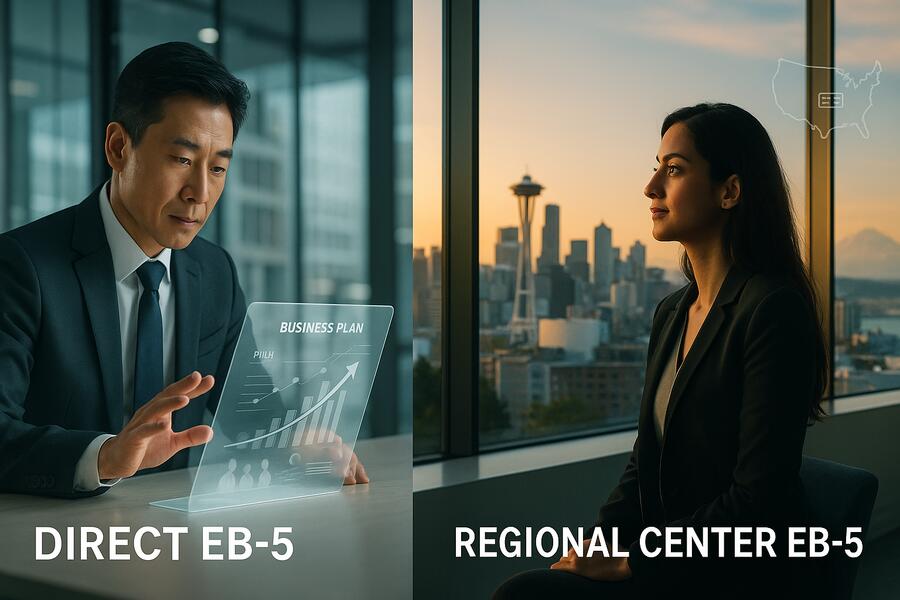
For high-net-worth individuals seeking a path to U.S. permanent residency through investment, the EB-5 Immigrant Investor Program offers a compelling opportunity. However, prospective investors often face a crucial decision: whether to pursue a direct EB-5 investment or to invest through a Regional Center. Understanding the nuances of direct EB-5 vs regional center comparison is vital for making an informed choice that aligns with your financial goals, management preferences, and risk tolerance.
At Ankeny Law, with offices in Seattle, WA, and Vancouver, BC, we regularly advise clients on the intricacies of the EB-5 program. While both pathways lead to the same immigration outcome – a green card – they differ significantly in terms of investor involvement, job creation methodologies, and the overall management of the investment. It’s not simply a matter of preference but often a strategic decision requiring careful consideration. To truly understand which path is best, it’s wise to get a consultation with experienced legal counsel.
Navigating Your EB-5 Investment Pathway: Direct vs. Regional Center
Direct EB-5 Investment: Taking the Reins
A direct EB-5 investment involves the investor directly establishing and managing a new commercial enterprise (NCE) in the United States. This path provides the investor with significant control over their business operations, allowing them to be actively involved in day-to-day decision-making, staffing, and strategic direction.
The primary advantage here is autonomy. You are the owner and operator, and the success of the business is directly tied to your efforts and management. This is often appealing to entrepreneurs who want full control over their venture in the U.S.
However, this direct involvement comes with specific responsibilities, especially regarding job creation. For a direct EB-5 investment, the NCE must create at least 10 full-time jobs for qualifying U.S. workers within two years. Crucially, these must be *direct* W-2 employee positions. Unlike Regional Center projects, you cannot count indirect or induced jobs created through economic modeling. This often means a higher direct employment burden and more rigorous documentation of each position.
💡 Key Takeaway: Direct EB-5 investments offer investors complete control over their business and hands-on management. The trade-off is the strict requirement for creating 10 verifiable W-2 direct jobs, without the benefit of indirect job counting.
Regional Center EB-5 Investment: The Passive Approach
The majority of EB-5 investments are made through the EB-5 Regional Center Program. A Regional Center is a USCIS-approved entity that sponsors various development projects and pools capital from multiple EB-5 investors into a single project. The investor’s role in a Regional Center project is typically passive; they invest their capital and rely on the Regional Center and its associated job-creating entity (JCE) to manage the project and ensure compliance with EB-5 requirements.
One of the most significant advantages of this path is the flexibility in job creation counting. Regional Center projects can count direct, indirect, and induced jobs. Direct jobs are those employed directly by the JCE. Indirect jobs are created in associated businesses that supply goods or services to the project. Induced jobs result from the spending of wages by direct and indirect employees within the local economy. This broader scope makes it generally easier to meet the 10-job creation requirement per investor.
While Regional Center investments offer less direct control, they can reduce the day-to-day management burden on the investor. The due diligence, however, shifts to thoroughly vetting the Regional Center itself, the specific project, and its economic models for job creation. It’s also important to remember that the Regional Center program is not permanent and requires periodic reauthorization by Congress, although it has historically been renewed.
💡 Key Takeaway: Regional Center EB-5 investments are typically passive, allowing investors to contribute capital without direct management. The primary benefit is the ability to count indirect and induced jobs, which often simplifies meeting the job creation quota.
Key Differences at a Glance: Direct EB-5 vs. Regional Center
To summarize the fundamental distinctions, consider this table comparing the two primary eb-5 project types:
| Feature | Direct EB-5 Investment | Regional Center EB-5 Investment |
|---|---|---|
| Investor Involvement | Active management, day-to-day operational control. | Passive investment; relies on Regional Center/JCE management. |
| Job Creation Counting | Only direct W-2 jobs (10 per investor). | Direct, indirect, and induced jobs (10 per investor). |
| Investment Structure | Investor creates or invests in their own NCE. | Pooled capital into a project sponsored by a USCIS-approved Regional Center. |
| Due Diligence Burden | Focus on business plan viability and direct job creation. | Focus on Regional Center reputation, project approval, economic impact report. |
| Program Stability | Permanent part of immigration law. | Requires periodic Congressional reauthorization (currently authorized until 2027). |
Which Path is Right for You?
The choice between a direct investment EB-5 and a Regional Center EB-5 hinges on several personal and professional factors:
- Desired Level of Control: If you’re an experienced entrepreneur eager to launch and run your own venture in the U.S., the direct investment path offers unmatched autonomy. If you prefer a more hands-off approach, allowing others to manage the investment while you pursue other interests, a Regional Center is likely more suitable.
- Risk Tolerance and Due Diligence: While both paths involve risk, the nature of that risk differs. Direct investors bear the entrepreneurial risk of their own business. Regional Center investors face the risk associated with the specific project and the Regional Center’s management, necessitating thorough due diligence on the project’s viability and compliance history.
- Job Creation Strategy: If your business model naturally supports hiring 10 direct W-2 employees within two years, a direct investment is viable. For projects where direct job creation might be challenging to scale or prove, or where the broader economic impact is significant, a Regional Center’s ability to count indirect and induced jobs offers greater flexibility.
- Investment Amount: The minimum investment amount is currently $800,000 for Targeted Employment Areas (TEAs) and infrastructure projects, and $1,050,000 for all other areas, for both direct and regional center investments.
💡 Key Takeaway: Your decision should align with your management preference (active vs. passive), your comfort with the specific job creation requirements, and the due diligence you’re willing to undertake for either your own business or a Regional Center project.
Choosing the right EB-5 investment structure is a pivotal decision with long-term implications for both your immigration status and your financial future. Consulting with an experienced immigration attorney is crucial to assess your unique situation and guide you toward the best option.
Have questions about professional concrete cleaning in Phoenix? Give us a call today.
Frequently Asked Questions About EB-5 Investment Types
Are the minimum investment amounts different for Direct EB-5 and Regional Center EB-5?
No, the minimum investment amounts are the same for both Direct EB-5 and Regional Center EB-5. Currently, it is $800,000 for projects located in Targeted Employment Areas (TEAs) or qualifying infrastructure projects, and $1,050,000 for investments outside of these areas.
What types of jobs count towards the 10-job creation requirement for each EB-5 type?
For Direct EB-5, only direct W-2 jobs created by the investor’s new commercial enterprise count. For Regional Center EB-5, direct, indirect, and induced jobs (calculated using approved economic methodologies) all count towards the 10-job requirement.
Does a Regional Center EB-5 investor have any say in the business operations?
Typically, Regional Center EB-5 investors take a passive role, meaning they do not have direct control over the day-to-day operations of the job-creating entity. Their involvement is usually limited to a role as a limited partner or similar passive stakeholder.
Is the Regional Center program permanent, like the Direct EB-5 program?
Unlike the Direct EB-5 program, which is a permanent part of U.S. immigration law, the Regional Center program requires periodic reauthorization by Congress. While it has been consistently reauthorized in the past, it does have a sunset date (currently September 30, 2027) that necessitates renewal.