
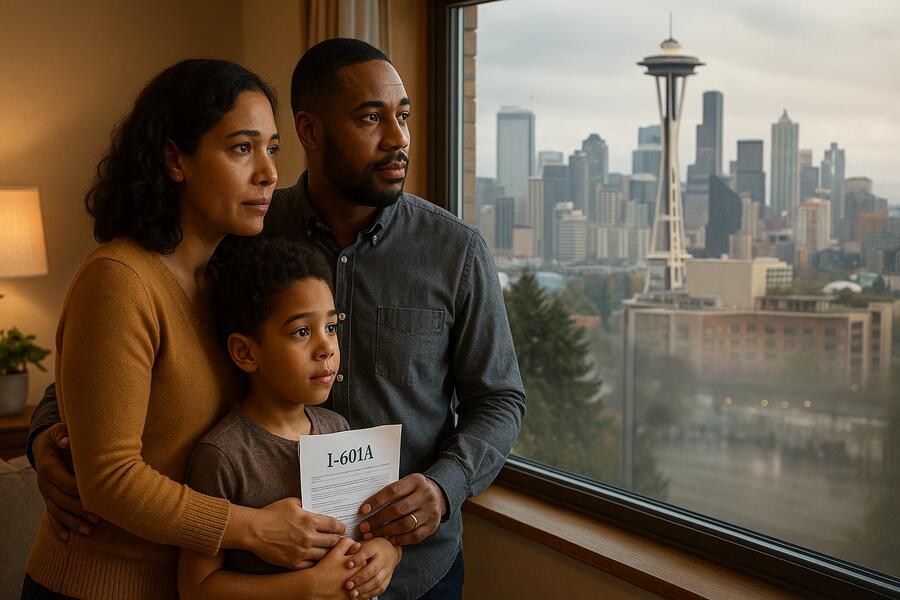
For individuals seeking lawful permanent residency in the United States, inadmissibility due to unlawful presence can be a significant hurdle. Fortunately, waivers exist to overcome these bars. Two critical waivers, the I-601 and the I-601A, serve similar purposes but have distinct processes and eligibility requirements. Understanding the nuances of the I-601A provisional waiver vs I-601 is crucial for anyone navigating this complex area of immigration law.
At Ankeny Law, with offices in Seattle, WA, and Vancouver, BC, our dedicated team provides expert guidance on these waivers. We often find that clients benefit greatly from understanding the differences, particularly how the I-601A offers a “stateside” process designed to minimize family separation. As experienced i-601 waiver lawyer, we can help determine which waiver is appropriate for your situation.
Understanding Grounds of Inadmissibility: The Unlawful Presence Bar
Before diving into the waivers, it’s essential to understand the “unlawful presence” ground of inadmissibility. If a foreign national accumulates more than 180 days but less than one year of unlawful presence and then departs the U.S., they are barred from re-entry for three years. If they accumulate one year or more of unlawful presence and then depart, they face a ten-year bar. These bars can prevent an otherwise eligible individual from obtaining a green card.
The Traditional I-601 Waiver: Filed Abroad
The Form I-601, Application for Waiver of Grounds of Inadmissibility, is a broad waiver that can cover numerous grounds of inadmissibility, including unlawful presence, certain criminal convictions, and immigration fraud or misrepresentation. Historically, this was the primary option for individuals who triggered the unlawful presence bar.
- When it’s filed: Typically, the I-601 waiver is filed *after* an immigrant visa interview at a U.S. consulate abroad. The consular officer determines the applicant is inadmissible, and only then can the I-601 be submitted.
- Qualifying Relative: To be eligible for an I-601 waiver based on unlawful presence or misrepresentation, the applicant usually needs to demonstrate that a qualifying U.S. citizen (USC) or Lawful Permanent Resident (LPR) spouse, child, or parent would suffer “extreme hardship” if the waiver is not granted.
- Impact on Family: This traditional process often meant that applicants would have to depart the U.S. and wait abroad for many months (sometimes over a year) for their waiver to be processed and approved, leading to prolonged family separation.
- Broader Scope: The I-601 is still the necessary waiver for individuals inadmissible due to grounds *other than* unlawful presence, such as certain criminal offenses or misrepresentation.
The I-601A Provisional Waiver: A “Stateside” Solution
Recognizing the hardship caused by long periods of family separation, USCIS introduced the Form I-601A, Application for Provisional Unlawful Presence Waiver, in 2013 (and expanded it in 2016). This waiver was specifically designed to address the unlawful presence bar for certain applicants *before* they depart the U.S. for their immigrant visa interview.
- When it’s filed: The I-601A is filed *while the applicant is physically present in the United States*. It is typically submitted after an I-130 Petition for Alien Relative has been approved and the applicant has paid their Department of State immigrant visa processing fee.
- Grounds of Inadmissibility: This is a critical distinction – the I-601A *only* waives the 3-year or 10-year unlawful presence bars. If the applicant has any other grounds of inadmissibility (e.g., criminal history, fraud, prior deportation orders), they are generally not eligible for the I-601A and would need to explore the traditional I-601 (if eligible for that specific ground) or other options.
- Qualifying Relative: Similar to the I-601, the applicant must demonstrate that their USC or LPR spouse or parent would suffer “extreme hardship” if the waiver is not granted. Unlike the I-601, children are generally *not* qualifying relatives for the I-601A, though their hardship can be considered in the overall extreme hardship analysis to the qualifying parent.
- Reducing Family Separation: The main benefit of the I-601A is that the applicant can remain in the U.S. with their family while the waiver is being adjudicated. Once the I-601A is provisionally approved, they travel abroad for their consular interview, significantly reducing the time spent separated from their family.
💡 Key Takeaway: The I-601A provisional waiver allows certain applicants to seek a waiver for unlawful presence *while in the U.S.* and have it provisionally approved before departing for their visa interview, drastically shortening family separation. The traditional I-601 is filed abroad and covers a broader range of inadmissibility grounds.
Eligibility for the I-601A Provisional Waiver
To be eligible for an I-601A waiver, an applicant must meet several strict criteria:
- Be physically present in the United States when filing the I-601A and for biometrics.
- Be at least 17 years old.
- Have an approved Form I-130 (or I-360) immediate relative petition.
- Have a pending immigrant visa case with the Department of State for the approved petition and have paid the DOS immigrant visa processing fee.
- Be inadmissible *only* for unlawful presence under INA Section 212(a)(9)(B) (the 3-year or 10-year bar).
- Have a qualifying U.S. citizen or LPR spouse or parent who would suffer “extreme hardship.”
- Not be in removal proceedings, unless those proceedings have been administratively closed and not recalendared.
- Not be subject to other grounds of inadmissibility (e.g., criminal history, fraud, prior deportation orders).
💡 Key Takeaway: The I-601A is highly specific. Eligibility is limited to immediate relatives of U.S. citizens or LPRs whose *sole* ground of inadmissibility is unlawful presence, and who can demonstrate “extreme hardship” to a qualifying U.S. citizen or LPR spouse or parent.
The Extreme Hardship Standard
Both the I-601 and I-601A waivers require demonstrating “extreme hardship” to a qualifying relative. This is a high legal standard that goes beyond mere economic detriment or emotional difficulty. USCIS considers a range of factors, including:
- The qualifying relative’s health (medical conditions, need for care).
- Financial hardship (loss of income, difficulty finding employment, significant debt).
- Education (disruption to schooling, special needs).
- Personal considerations (close family ties, community involvement, cultural assimilation).
- Country conditions (danger, lack of medical care, political instability in the country of relocation).
The hardship must be to the *qualifying relative*, not solely to the applicant or other family members. A compelling case requires extensive documentation and a well-reasoned legal argument.
Key Differences at a Glance: I-601 vs. I-601A
| Feature | I-601 Waiver | I-601A Provisional Waiver |
|---|---|---|
| Grounds Waived | Multiple grounds (unlawful presence, misrepresentation, certain crimes) | Only unlawful presence (3-year or 10-year bar) |
| Filing Location | U.S. Embassy/Consulate abroad (after visa denial) | USCIS Lockbox facility in the United States (before departure) |
| Applicant’s Location During Processing | Abroad, separated from family | In the United States, with family |
| Qualifying Relative | USC/LPR spouse, parent, *or child* | USC/LPR spouse or parent (children generally not QRs) |
| Purpose | Overcome various inadmissibility findings after consular interview | Obtain waiver approval before leaving U.S. for consular interview, reducing time abroad |
Navigating Waiver Applications with Ankeny Law
The process of applying for an I-601 or I-601A waiver is incredibly detailed and requires a deep understanding of immigration law and policy. From gathering extensive evidence to crafting a compelling “extreme hardship” argument, professional legal assistance is paramount.
At Ankeny Law, our immigration attorneys in Seattle, WA, and Vancouver, BC, have a proven track record of successfully guiding clients through complex waiver applications. We work closely with you to assess your eligibility, meticulously prepare your petition, and present the strongest possible case to USCIS. Our goal is to minimize your time spent separated from family and help you achieve your dream of lawful permanent residency in the U.S.
Frequently Asked Questions About I-601 and I-601A Waivers
What if I have other grounds of inadmissibility besides unlawful presence?
If you have any other grounds of inadmissibility, such as certain criminal convictions, misrepresentation, or a prior deportation order, you are generally not eligible for the I-601A provisional waiver. In such cases, you would need to explore whether an I-601 waiver (or another type of waiver) is applicable for those specific grounds, which would typically be filed after a consular interview abroad.
What is “extreme hardship” and how do I prove it?
“Extreme hardship” is a high legal standard that requires demonstrating that your qualifying U.S. citizen or LPR spouse or parent would suffer more than the normal difficulties associated with family separation or relocation. Proof can include medical records, psychological evaluations, financial documents, letters from employers/schools, proof of community ties, and evidence of country conditions if relocation is considered. A detailed legal brief is crucial.
Can I-601A provisional waivers be revoked?
Yes, an I-601A provisional waiver can be revoked. This can happen if, during the consular interview, the consular officer discovers other grounds of inadmissibility that were not disclosed or known at the time of the I-601A filing, or if there were issues with misrepresentation in the original application. This underscores the importance of being completely transparent and thoroughly prepared with your attorney.
Does having an approved I-130 petition make me automatically eligible for an I-601A?
No, an approved I-130 petition is a necessary first step, but it does not automatically make you eligible for an I-601A. You must also meet all other strict eligibility criteria for the I-601A, including being inadmissible only for unlawful presence, having a qualifying U.S. citizen or LPR spouse or parent, and demonstrating extreme hardship to that relative.