
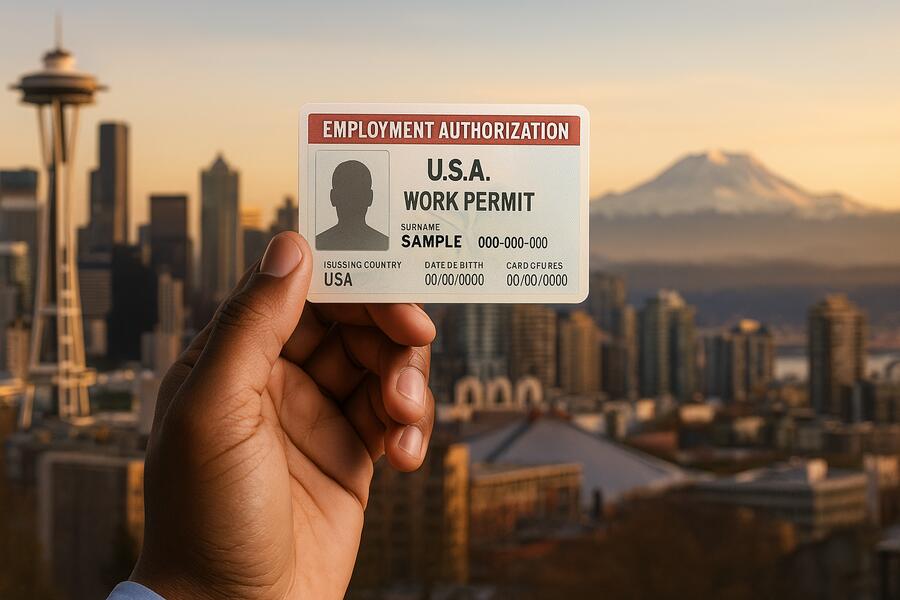
For many non-U.S. citizens residing in the United States, the ability to work legally is paramount. While some immigration statuses inherently grant work authorization, many others require a specific document to permit employment. This critical document is known as the Employment Authorization Document (EAD), often referred to as an “EAD card” or simply a “work permit.” Understanding when and why you need one, and how to obtain it, is essential for maintaining lawful employment in the U.S.
At Ankeny Law, serving clients in Seattle, WA, and Vancouver, BC, we frequently encounter individuals who are unsure about their work eligibility. The complexities of U.S. immigration law mean that eligibility for an EAD varies significantly depending on your specific immigration status. Without proper work authorization, accepting employment can lead to serious immigration consequences. This is why it’s vital to understand the nuances of the employment authorization document explained. For specific guidance on your situation or if you’re exploring options, consulting with a qualified work visa attorney can provide clarity and ensure compliance.
What is an Employment Authorization Document (EAD)?
An Employment Authorization Document, or EAD, is an official credit card-sized document (Form I-766) issued by U.S. Citizenship and Immigration Services (USCIS) that proves a non-U.S. citizen is authorized to work legally in the United States for a specific period. It acts as verifiable proof for employers that you are legally allowed to work and also enables you to apply for a Social Security number.
Who Needs an EAD?
Not every non-U.S. citizen requires an EAD to work. For example, lawful permanent residents (Green Card holders) and U.S. citizens have inherent work authorization. However, many other immigration categories require an EAD before an individual can legally be employed. Generally, if your immigration status does not automatically grant work authorization, you likely need an EAD.
-
Applicants for Adjustment of Status (Green Card Applicants)
If you have a pending Form I-485, Application to Register Permanent Residence or Adjust Status, you are typically eligible to apply for an EAD. This allows you to work while your green card application is processed, which can often take many months or even years.
-
Asylum Applicants and Refugees
Individuals who have applied for asylum and whose application has been pending for at least 150 days, as well as those granted refugee status, are eligible for an EAD. This provides crucial work authorization as they navigate their protection claims.
-
Dependents of Certain Visa Holders
Spouses of certain nonimmigrant visa holders, such as L-1 (intra-company transferees) and E (treaty traders/investors) visa holders, are often eligible for EADs. This allows families to contribute to the U.S. economy while their primary visa holder works.
-
DACA Recipients
Beneficiaries of the Deferred Action for Childhood Arrivals (DACA) program receive work authorization through an EAD, which must be renewed periodically.
-
Temporary Protected Status (TPS) Holders and Parolees
Individuals granted Temporary Protected Status or who have been paroled into the U.S. for humanitarian reasons are typically eligible for an EAD.
💡 Key Takeaway: The need for an EAD depends entirely on your specific immigration status. If you’re unsure whether your status allows you to work without one, always verify with USCIS or an immigration attorney.
Applying for Your EAD: The I-765 Process
To obtain an EAD, eligible individuals must file Form I-765, Application for Employment Authorization, with USCIS. This application requires specific supporting documentation, which varies based on your eligibility category.
-
Required Documents
Typically, you’ll need to submit copies of your most recent I-94 Arrival/Departure Record, passport identity pages, previous EADs (if renewing), and documents proving your eligibility for the specific EAD category you’re applying under. For example, I-485 applicants will include a copy of their I-485 receipt notice.
-
Filing Fees
Most EAD applications require a filing fee, which can be paid via check or money order to the U.S. Department of Homeland Security. Fee waivers may be available for certain categories of applicants who meet specific income guidelines.
-
Biometrics and Processing Times
Some EAD applicants may be required to attend a biometrics appointment to provide fingerprints, photographs, and a signature. Processing times for Form I-765 can vary significantly, ranging from a few months to over a year, depending on the USCIS service center and the specific eligibility category.
EAD Expiration and Renewal: Crucial Considerations
An EAD is typically granted for a specific period, usually one or two years, and it’s essential to manage its expiration carefully to avoid gaps in employment authorization.
-
Renewal Process
If your EAD is nearing expiration and you remain eligible for work authorization, you should file a new Form I-765 for renewal. It’s recommended to apply for renewal approximately 120-180 days before your current EAD expires, as processing times can be lengthy.
-
Automatic Extensions for Renewals
For certain EAD categories, if you file a timely renewal application (before your current EAD expires), you may be eligible for an automatic extension of your work authorization for a period of up to 540 days. This allows you to continue working legally while your renewal application is pending. Your expired EAD card, along with the I-797C receipt notice for your I-765 renewal, serves as proof of this automatic extension.
-
Lost, Stolen, or Destroyed EADs
If your EAD card is lost, stolen, or destroyed, you can apply for a replacement by filing a new Form I-765 and paying the associated fee (unless a fee waiver is approved).
💡 Key Takeaway: Timely renewal is critical. Be aware of your EAD’s expiration date and file for renewal well in advance. Check if your category is eligible for an automatic extension to prevent employment gaps.
Unrestricted vs. Category-Restricted EADs
Most EADs grant “unrestricted” work authorization, meaning you can work for any employer in any position. However, some EADs, while rare, may come with certain restrictions depending on the underlying immigration status. It’s crucial to understand the specific category under which your EAD is issued (indicated by a code on the card) and any limitations that may apply.
| EAD Eligibility Category | Common Description | Key Point |
|---|---|---|
| (c)(9) | Pending Adjustment of Status (I-485) | Allows work while green card application is processed. |
| (c)(8) | Pending Asylum Application | Available if asylum application pending for 150+ days. |
| (a)(5) | Refugee | Granted to individuals with refugee status. |
| (c)(33) | DACA Recipient | For individuals granted Deferred Action for Childhood Arrivals. |
| (a)(10) | Granted Withholding of Removal | For individuals granted withholding of removal. |
💡 Key Takeaway: An EAD is a temporary work permit and does not grant permanent residency or U.S. citizenship. It is a crucial bridge for many non-citizens to legally work in the U.S. while pursuing other immigration goals.
The Employment Authorization Document is a vital component of the U.S. immigration system, enabling many non-citizens to pursue employment opportunities lawfully. Understanding the nuances of work authorization USA requirements, eligibility categories, and the application process for an EAD is crucial for maintaining compliance and securing your ability to work. When in doubt, seeking professional legal advice can save you from potential missteps and ensure a smooth path forward.
An EAD often works alongside another underlying visa status. If that status is a specialty-occupation role, see our guide to the H-1B visa; if it is an intracompany transfer, see the L-1 visa.
Frequently Asked Questions About EADs
Is an EAD the same as a work permit?
Yes, an EAD (Employment Authorization Document) is commonly referred to as a “work permit.” These terms are used interchangeably and refer to the same official card (Form I-766) issued by USCIS, which grants certain non-U.S. citizens permission to work in the United States.
Can I travel internationally with an EAD?
An EAD itself does not grant re-entry into the United States. While it authorizes you to work, it does not function as a travel document. If you plan to travel internationally, you will typically need a valid passport and, depending on your underlying immigration status, a valid visa or a separate advance parole document to ensure you can re-enter the U.S. Consult an immigration attorney before any international travel if you only hold an EAD.
How long is an EAD typically valid for?
The validity period of an EAD usually ranges from one to two years, depending on your specific immigration category and current USCIS policies. It’s crucial to check the expiration date on your EAD card and initiate the renewal process well in advance to avoid any gaps in your work authorization.
What happens if my EAD expires and my renewal is still pending?
For certain EAD categories, if you file a timely renewal application (before your current EAD expires), your work authorization may be automatically extended for up to 540 days. This means you can continue working legally during this extension period. You’ll use your expired EAD card along with the I-797C receipt notice for your I-765 renewal application as proof of your extended work authorization for your employer.